

Comparison of Seal Manufacturing Technologies for Hydraulics
Sealing elements used in hydraulic cylinders are manufactured using two primary technologies. These are:
- Injection Molding Technology (Injection Molding)
- CNC Turning Technology (CNC Turning)
Each of these technologies has its advantages and disadvantages and is suitable for different situations. A comparison of both technologies can be found below. More information about our production capabilities can be found here.
Injection Molding Technology
Process:
- Injection of plastic or elastomer into a mold under high pressure, where the material hardens.
- Primarily used for thermoplastics and elastomers.
Advantages:
- High-volume production: The technology is suitable for manufacturing large series with a low unit cost.
- Repeatability: Each piece produced by injection molding has consistent dimensions and quality.
- Complex shapes possible: The injection mold allows for the production of seals with very complex geometries.
- Production speed: Once the mold is created, a large number of pieces can be produced quickly.
Disadvantages:
- Initial costs: High costs for manufacturing injection molds, which can be uneconomical for small series.
- Mold accuracy demands: Any design change requires modification or a new mold, which can be time-consuming and costly.
CNC Turning Technology
Process:
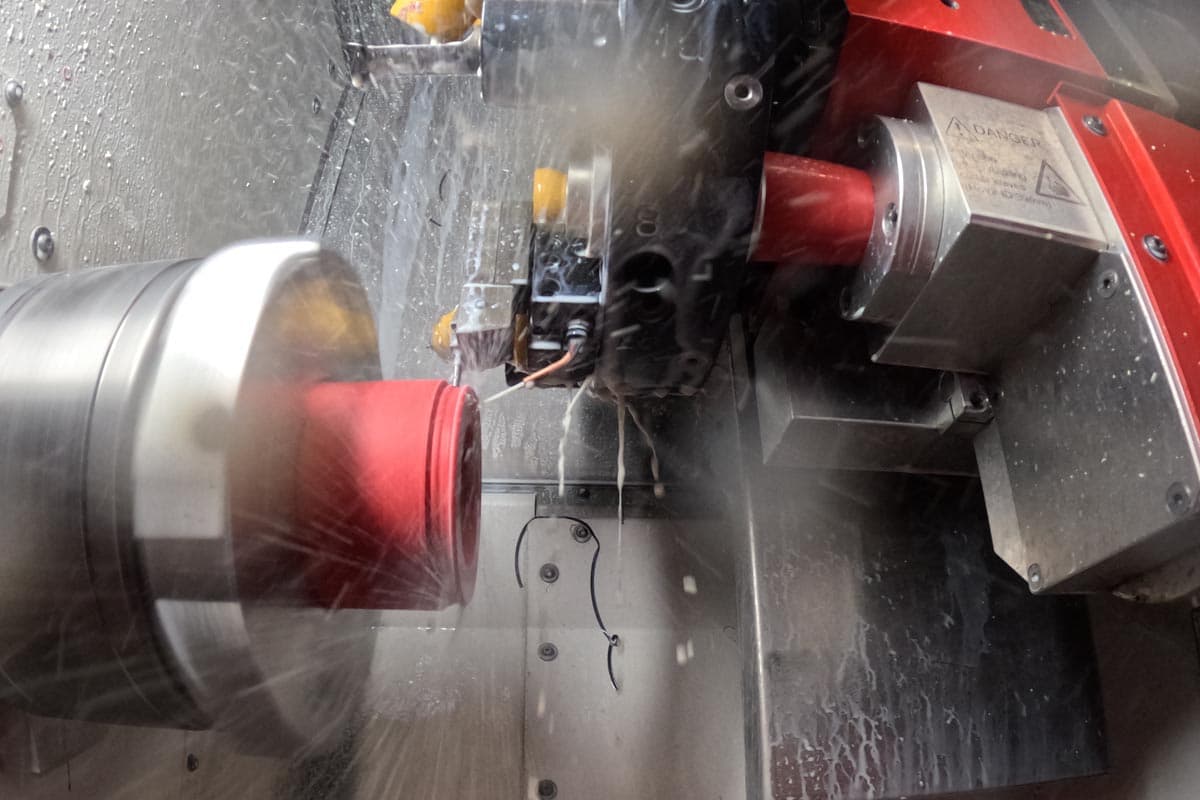
- Seals are manufactured by removing material from a blank using a computer-controlled CNC lathe.
Advantages:
- Flexibility: CNC technology allows for rapid adaptation to design changes without the need to produce new molds.
- High precision: CNC machines achieve very high precision and are ideal for manufacturing seals with tight tolerances.
- Suitable for small series and prototypes: Production costs are not quantity-dependent, making this method suitable for small series or one-off orders.
- Wide range of materials: CNC turning allows for working with various materials, including metals and special plastics.
Disadvantages:
- Slower production: The process is more time-consuming compared to injection molding.
- Higher unit costs: For large series, the cost per piece can be higher than with injection molding.
- Less complex shapes: Turning is more suitable for simpler geometries, while more complex shapes may be more difficult to achieve.
Seal Manufacturing Technology
- Injection molding is more advantageous for high-volume production of seals with complex shapes and requirements for low unit cost. It is suitable for long-term projects where initial mold costs are justified.
- CNC turning is ideal for small series, prototypes, or applications requiring high precision and rapid design modifiability.
| Factor | Injection Molding | CNC Turning |
|---|---|---|
| Suitability for Series Production | High (for large volumes) | High (for small volumes) |
| Initial Investment | High (tools, molds) | Low (machine setup) |
| Unit Cost | Low for large series | Higher, especially for large series |
| Design Adaptability | Low (requires new molds) | High (software modification) |
| Precision | High, but dependent on mold quality | Very high, independent of geometry |
| Production Time | Short (after mold production) | Longer (more time-consuming) |
| Complexity of Shapes | High | More limited (simpler geometries) |