

In many industries, technical components come into direct or indirect contact with food, beverages, or raw materials used in their production. In such applications, it is essential to use materials that meet strict hygiene and health requirements. One of the most commonly required standards is the FDA standard, which customers often refer to as a “food-grade certification.”
Article Contents
What is the FDA, and what regulations govern food-contact materials?
The FDA is a U.S. federal agency that, among other things, establishes requirements for materials intended to come into contact with food. Technical materials used in food processing facilities are most often evaluated according to the regulations set forth in Title 21 of the Code of Federal Regulations (CFR).
If a material is labeled as “FDA compliant” or “FDA approved” for a given application, this means that it meets the requirements defined in FDA regulations for use in contact with food.
It is important to note that the FDA generally does not approve individual finished products, but rather establishes requirements for the composition of materials and their use. The material manufacturer then declares compliance with the relevant regulations.
The FDA vs. European Legislation
In the European context, we often encounter Regulation (EC) No. 1935/2004 of the European Parliament and of the Council, which regulates materials and articles intended to come into contact with food.
Materials used in the food industry may therefore meet the following requirements:
- FDA (U.S.)
- Regulation ( EC) No. 1935/2004
- EU Regulation 10/2011 on Plastic Materials
- other national or industry-specific requirements
Many modern engineering plastics and elastomers meet both FDA and European regulatory requirements, which facilitates their use in international projects.
What materials are most commonly used in the food industry?
PTFE virgin
PTFE virgin is a highly versatile fluoroplastic with exceptional properties. Its extremely low coefficient of friction, excellent chemical resistance and stability over a wide temperature range make it one of the most widely used engineering plastics. It is electrically non-conductive, resistant to ageing and moisture.
It is resistant to almost all chemicals, has excellent sliding properties and high resistance to ageing. The material is FDA approved and can be used in the food industry. Due to its lower elasticity, pure Teflon is not suitable for higher mechanical loads. The material also has a lower resistance to abrasion. For more demanding applications, it is therefore preferable to use one of the PTFE-filled variants.
Material temperature resistance: -200 °C to +260 °C
Examples of products and uses:
Seals and insulating elements, slip rings and washers, parts for the chemical industry, electrical insulation components, food and pharmaceutical applications, tank and pipe linings, plain bearings and valves.
MVQ Rubber – Silicone, Rubber for the Food Industry
Silicone rubber is mainly used in the food industry due to the fact that it does not affect the taste or smell of the medium with which it is in contact.
Compared to other materials, it offers high flexibility at low temperatures (while maintaining properties), very good temperature resistance. Rubber has excellent resistance to UV radiation, ozone, atmospheric influences and aging.
The rubbers are FDA-approved (FDA 21 177.2600, BfR XV, KTW BGBI 28-12) and can be used in the food industry.
Its non-absorbent and water-impermeable properties, its lack of impact on the taste and odor of the medium with which it comes into contact (it is bacteriologically non-degradable), and the fact that it does not stain are the reasons why it is widely used, particularly in the food industry.
Rubber is not resistant to prolonged exposure to superheated steam.
Examples of Products and Applications
Sealing elements in direct contact with products of the food industry. Pharmaceutical industry. Heat-stressed products.
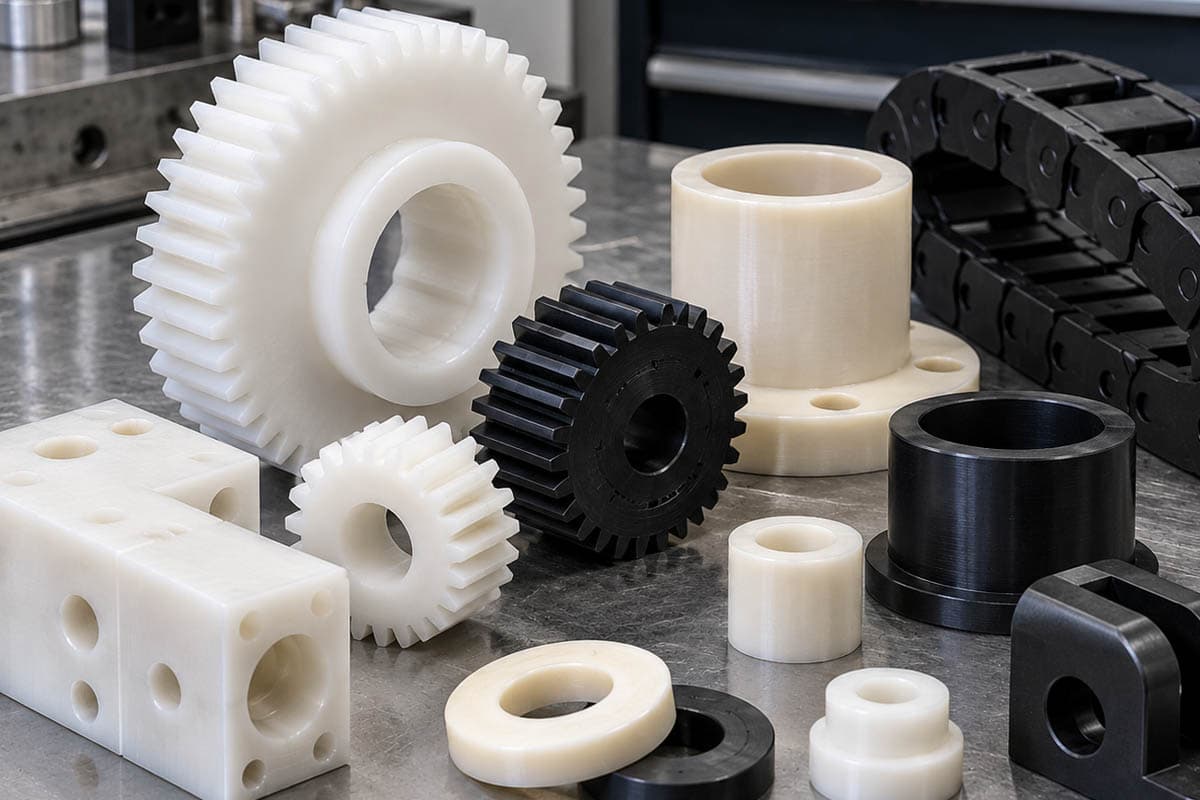
POM-C (polyacetal)
POM-C (known as polyacetal) is an engineering plastic with excellent mechanical properties, low friction, and high dimensional stability.
Thanks to its strength and resistance to wear and chemicals, it is widely used in industrial applications, particularly in the manufacture of precision structural components and sliding parts.
The material’s temperature resistance ranges from -50° to +100°C
Examples of products and uses:
Bearings, piston rings, seals, sliding components, guide components, ventilation housings, covers, coil housings, pump components, gear components, gears.
PE 1000 / PE-UHMW
PE1000 polyethylene is primarily used in applications where the material must meet high requirements for low coefficient of friction and high abrasion resistance. It excels in its exceptional sliding properties, extreme wear resistance, high impact toughness, and considerable chemical resistance.
The material’s temperature resistance ranges from -150° to +80°C
Examples of products and uses:
Chain guides, conveyor belts, guides for conveyor belts and production lines, self-lubricating slide bushings, bearings and guide rails, protective linings for hoppers and bins, impact surfaces, and components for preservation and filling lines.
A summary of all the materials in our product lineup that are FDA-certified can be found in our materials database.
What should you look for when choosing a material?
When selecting an FDA-certified material, it is not enough to consider the certification alone. You must also take the following into account:
Media Type
The material may come into contact with a wide variety of substances. In the food industry, for example, the material comes into contact with:
- with water
- dairy products
- drinks
- fats and oils
- sugar solutions
- cleaning chemicals
Each medium can have a different effect on a material, and it is therefore necessary to assess the suitability of the material, particularly with regard to long-term exposure to the substance in question.
Operating temperature
Some materials are suitable only for normal operating temperatures, while others can withstand steam sterilization or high-temperature washing. It is therefore always necessary to assess whether a material can withstand temperature demands over the long term and whether its properties change at different temperatures (for example, some materials become brittle and lose flexibility at low temperatures).
Mechanical load
It is necessary to take into account pressure, friction, speed of movement, and the required service life of the part. Mechanical and pressure stresses significantly influence the choice of material, as materials often differ significantly from one another in these physical properties.
Required Documentation
When selecting a material, it is, of course, also necessary to verify that the material complies with legal requirements and meets all certification and testing standards. Traceability of a specific batch of raw material is also often required.

How can we help you with FDA-related materials?
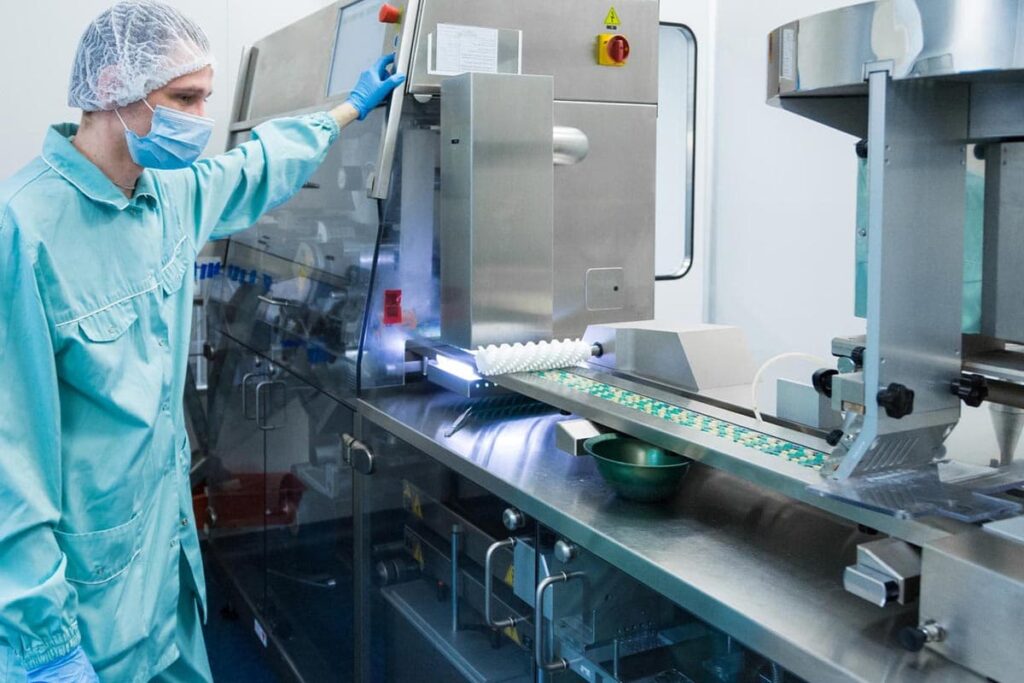
Thanks to our technologies, we are able to process and manufacture a wide range of parts from FDA-approved materials. Whether it’s rubber products, engineering plastic parts, sealing elements, or, for example, custom-made flat gaskets. We can issue a Declaration of Compliance with FDA requirements for each order and also provide a material data sheet to support it. We also have an optical measuring device that allows us to inspect finished products with maximum precision and thus verify compliance with dimensional tolerances using a dimensional report. Furthermore, thanks to our ISO certification, we can guarantee that production takes place under conditions and in a manner that meet all legal requirements and standards.
Based on our many years of experience, we have worked with clients across both the food and pharmaceutical industries. These include, for example, dairies, pharmaceutical manufacturers, manufacturers of food processing machinery, beverage filling line manufacturers, cosmetics manufacturers, and other facilities where it is necessary to comply with FDA requirements and use only materials approved for these purposes.
FAQ – Frequently Asked Questions
What does FDA stand for?
FDA indicates that the material complies with the U.S. Food and Drug Administration’s requirements for use in contact with food.
What is the difference between FDA approval and food certification?
The FDA certifies that a material complies with U.S. regulations for food contact. In practice, the term “food contact certification” is generally used for materials approved for contact with food.
The FDA vs. European Legislation
In the European context, we often encounter Regulation (EC) No. 1935/2004 of the European Parliament and of the Council, which regulates materials and articles intended to come into contact with food. Many materials meet the requirements of both the FDA and European legislation, which facilitates their use in international projects.
Which materials are most commonly available with FDA certification?
Commonly used materials include PTFE, POM, PE-UHMW, silicone, EPDM, and certain other engineering plastics and elastomers.
Summary
In the food and pharmaceutical industries, all components that come into contact with the final product must be made of materials that meet strict hygiene requirements and do not adversely affect human health. These requirements are described and established by several standards, the most well-known of which are the FDA regulations and European Regulation (EC) No. 1935/2004. Materials for the food industry must therefore be selected to ensure compliance with these legislative requirements.
Are you looking for a material that meets FDA requirements? Our product range includes a wide variety of materials that comply with FDA certification, which we can use to manufacture custom products not only for the food industry.