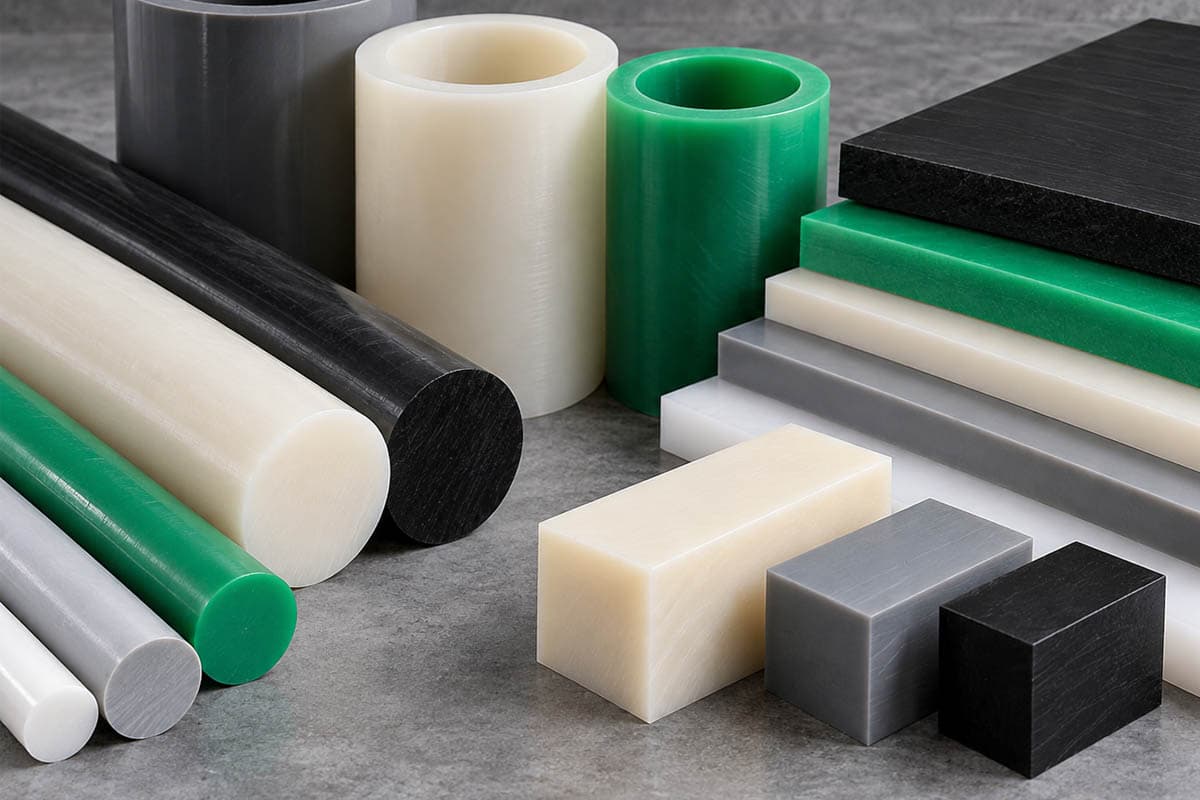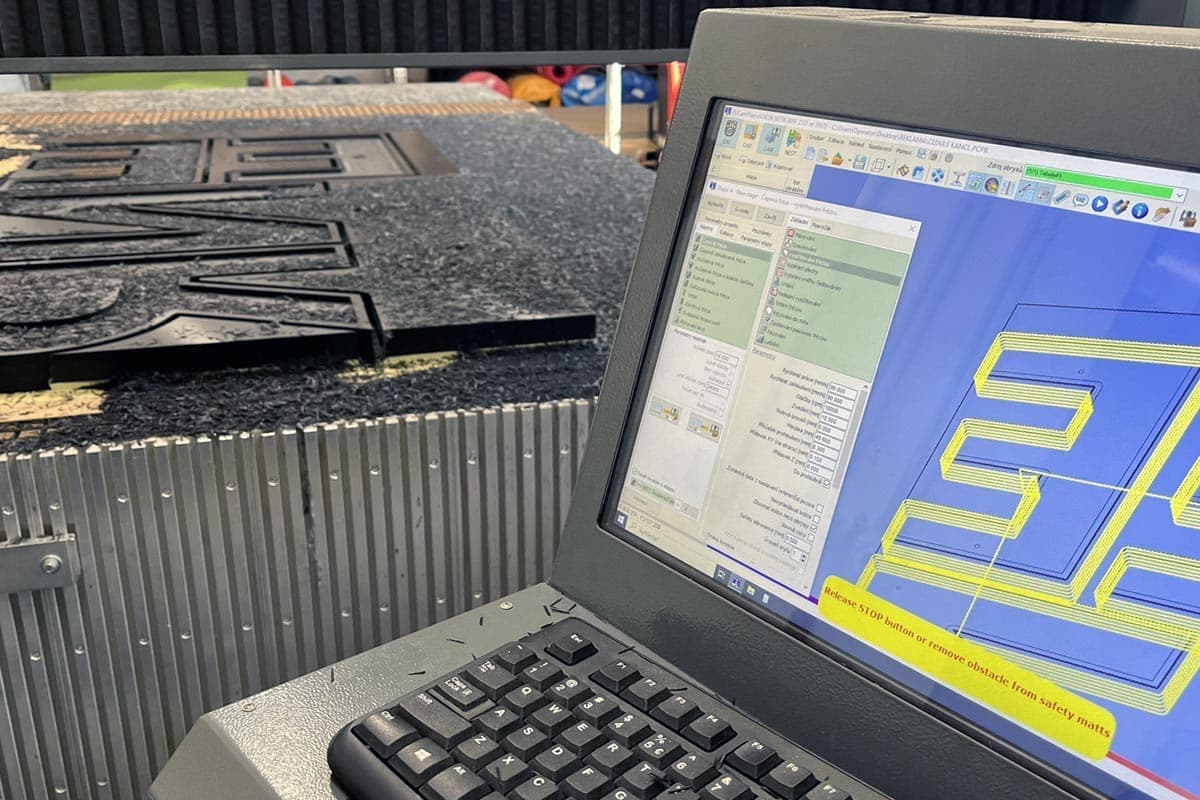


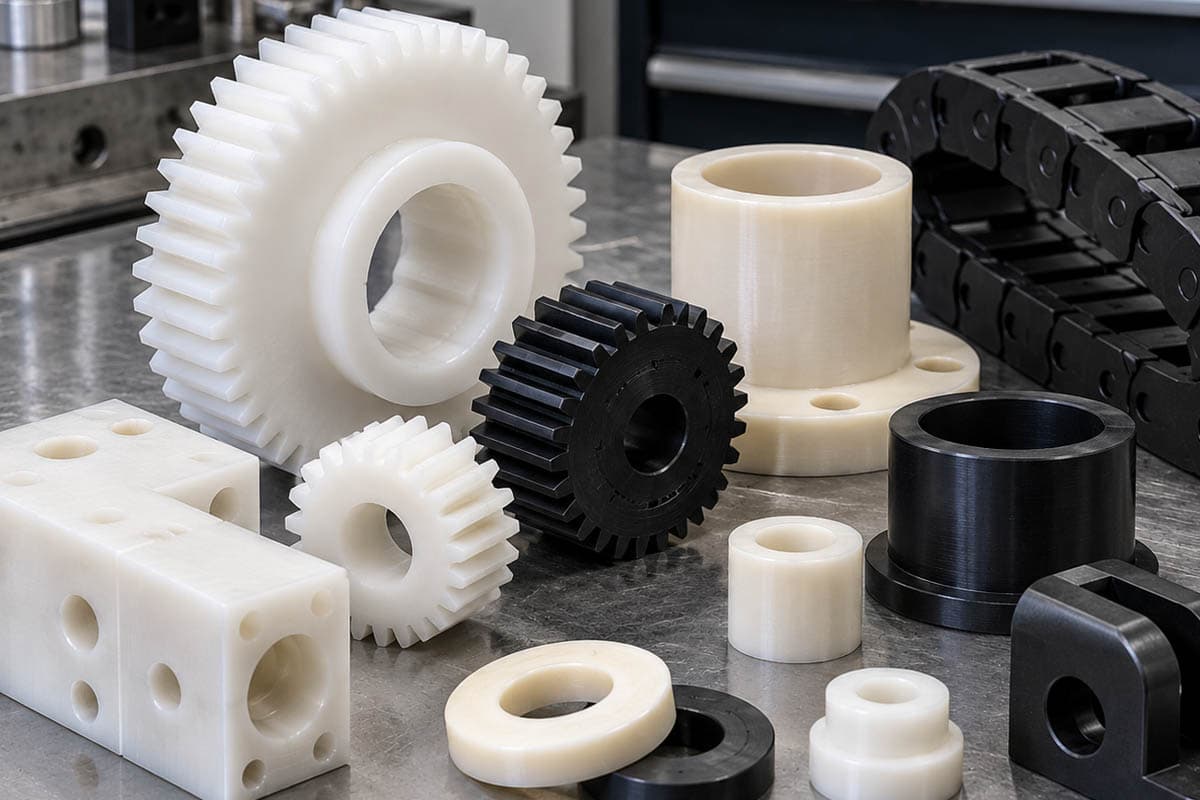
Polyamide PA6 is one of the most widely used engineering plastics in the machinery industry. In practice, you may also encounter the names Nylon, Nylon 6, or Silon. The material is primarily used in applications requiring good mechanical strength, toughness, low friction, and wear resistance.
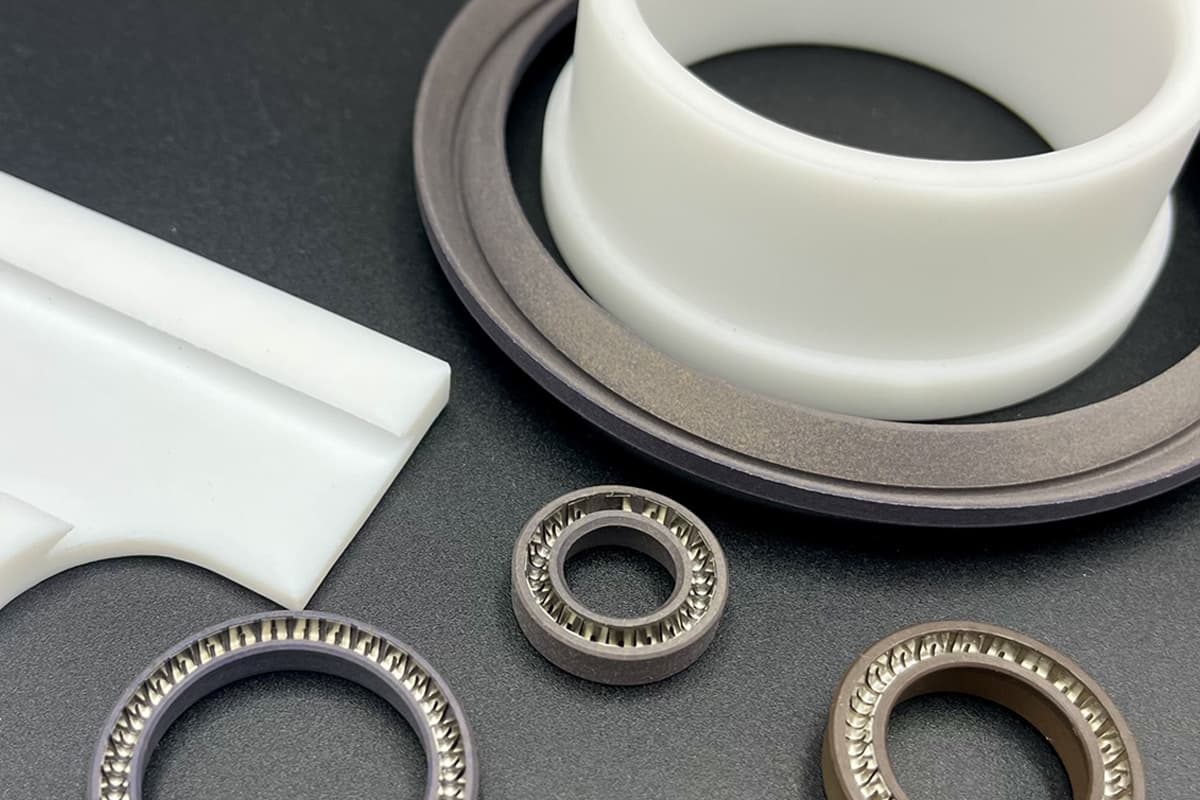
Thanks to its good machinability, PA6 is also suitable for CNC machining. Milling and turning can be used to produce bushings, pulleys, gears, guide elements, spacers, structural parts, and a wide range of other components from polyamide.
Here at REONTECH CZ s.r.o., we provide CNC milling and CNC turning services for PA6 polyamide and other engineering plastics. We manufacture individual parts and prototypes, as well as repeat and mass-production orders based on technical drawings or a supplied sample.
Table of Contents
Are polyamide, PA6, nylon, and silon the same material?
These terms are often used in the Czech industrial sector to refer to the same material, but it is important to know their exact meanings.
Polyamide (PA) refers to an entire group of engineering polymers. These include, for example, PA6, PA66, PA12, and other variants.
PA6, or polyamide 6, is a specific type of polyamide, and that is what we will focus on in this article.
Nylon 6 is the standard international designation for a material with the same polymer base as PA6.
“Silon ” is a name that has historically been widely used in the Czech Republic to refer to polyamide 6. In everyday technical communication, you may therefore still come across terms such as “silon rod,” “silon sleeve,” or “silon machining.”
For the purposes of this article, therefore, the terms “Polyamide PA6,” “Nylon 6,” and “Silon” all refer to the material PA6.
What are the properties of polyamide PA6?
PA6 is a versatile engineering plastic that combines relatively low weight with good mechanical properties. As a result, it can replace metal parts in a variety of applications.
The main properties of polyamide PA6 include:
- high toughness and mechanical strength,
- good wear resistance,
- good gliding properties,
- the ability to dampen shocks, noise, and vibrations,
- good resistance to oils and lubricants,
- low weight compared to metal materials,
- good machinability by both milling and turning,
- a wide range of applications in mechanical engineering.
It is precisely this combination of mechanical strength and low-friction properties that makes PA6 ideal for the manufacture of bearings, bushings, pulleys, guide elements, and gears, for example.
PA6 and Moisture Absorption
One of the important properties of polyamide is its ability to absorb moisture from the surrounding environment. This can affect the dimensions and certain mechanical properties of the finished part.
This factor is particularly important for components with very tight tolerances. During the design and CNC machining of PA6 , it is therefore necessary to take into account not only the product’s geometry but also its future operating conditions.
If very high dimensional stability is the primary requirement, POM, for example, may be more suitable in certain applications. Conversely, PA6 offers an advantageous combination of toughness, wear resistance, and sliding properties.
What types of polyamide are there?
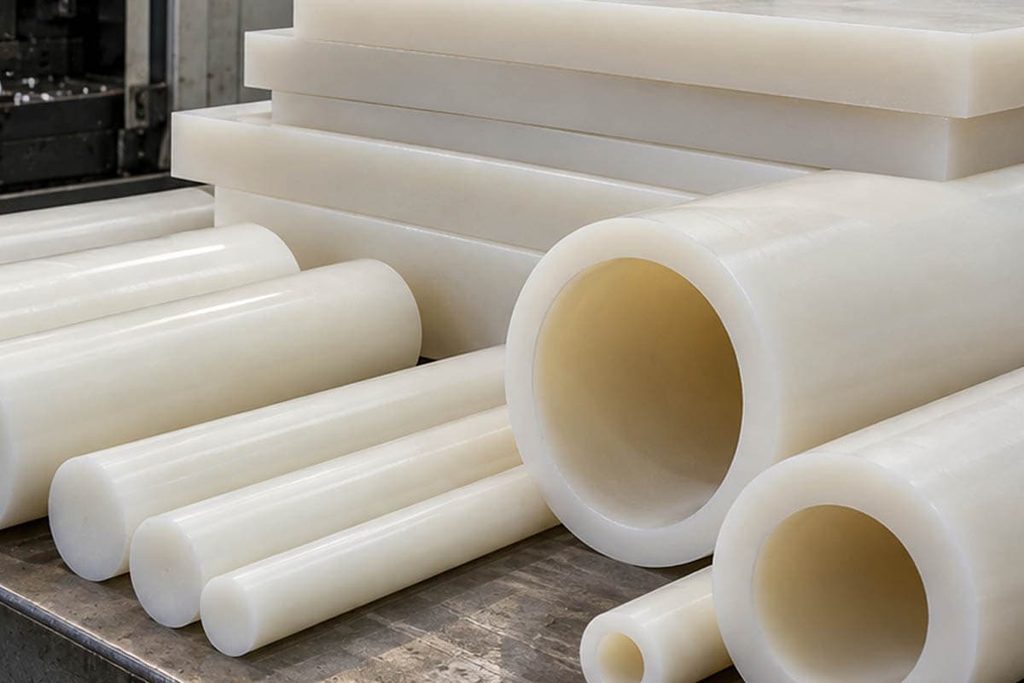
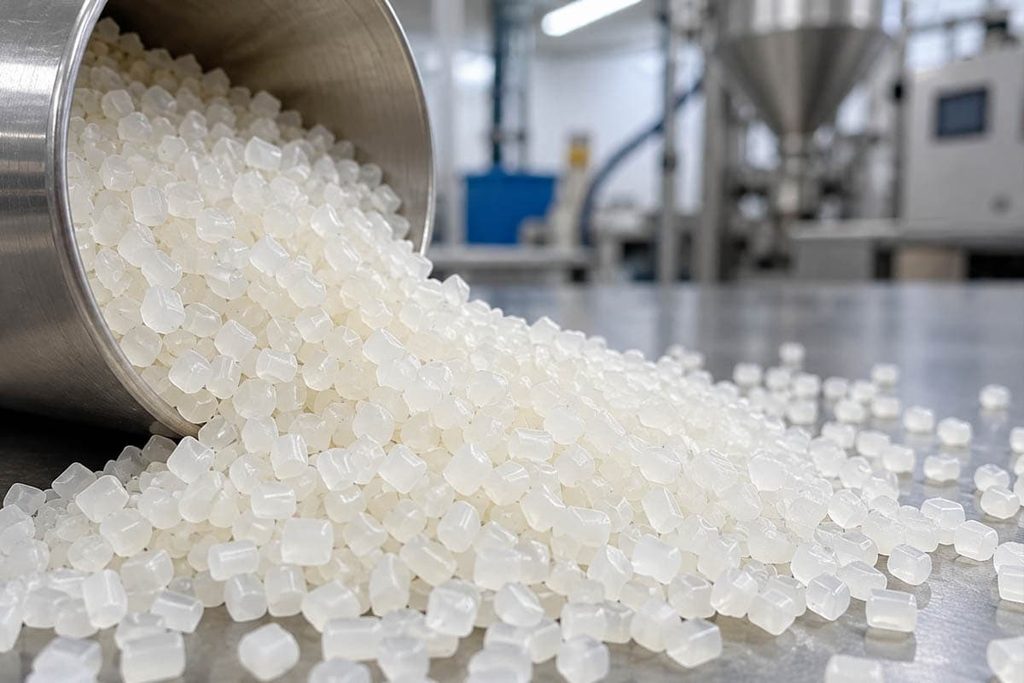
The term “polyamide” encompasses an entire group of materials. In addition to the basic PA6, there are other types and modifications designed, for example, for higher mechanical loads, better sliding properties, higher temperatures, or greater dimensional stability.
The choice of a specific type of polyamide can significantly affect both the service life and functionality of the final part.
PA6 – standard polyamide 6
PA6 is one of the most widely used engineering polyamides. It offers a good combination of toughness, strength, wear resistance, and sliding properties.
It is used, for example, for:
- cases,
- pulleys,
- gears,
- guide elements,
- rollers,
- structural components,
- various machine parts.
PA6 can be processed very well using CNC milling and CNC turning.
PA6G, or cast polyamide 6
PA6G, also known as cast polyamide, cast nylon, or PA6 C, is produced by polymerization directly in the mold.
Compared to some extruded variants, it allows for the production of large-sized semi-finished products and is characterized by very good sliding and wear-resistant properties.
Typical uses include:
- large pulleys and belt pulleys,
- gears,
- guide segments,
- sliding bearings,
- support plates,
- rollers,
- parts subjected to high mechanical stress.
Cast PA6 is also available in a range of modified grades.
PA6 + oil – oil-modified polyamide
PA6+oil, also known as oil-filled polyamide or oil-filled Silon, is a modified polyamide with a lubricant incorporated directly into the material’s structure.
Very often, it is a type of cast polyamide PA6.
The addition of oil primarily improves the material’s sliding properties and wear resistance. The material is therefore particularly suitable for applications where external lubrication is difficult or undesirable.
Typical uses:
- sliding bushings,
- sliding bearings,
- guide rails,
- pulleys and rollers,
- gears,
- moving machine parts.
CNC machining of PA6+oil enables the production of precision sliding components directly from rods, sheets, or other semi-finished products.
PA6 MoS₂ – polyamide with molybdenum disulfide
Another option is PA6 modified with molybdenum disulfide (MoS₂).
This additive is used primarily to modify the material’s lubricity, wear resistance, and mechanical properties.
PA6 MoS₂ is used, for example, for:
- sliding bushings,
- guide elements,
- gears,
- rollers,
- machine components under stress.
Depending on the manufacturer and the specific formulation, the properties of individual materials may vary; therefore, it is advisable to refer to the technical data sheet for the specific semi-finished product when designing.
PA6 GF30 – glass-fiber-reinforced polyamide
The designation PA6 GF30 refers to polyamide PA6 reinforced with approximately 30% glass fiber.
Glass fibers significantly increase, above all:
- stiffness,
- strength,
- dimensional stability,
- Resistance to deformation under mechanical stress.
PA6 GF30 is therefore used for structural components that must be significantly stiffer than parts made from standard PA6.
However, when machining, it is important to keep in mind that glass fibers have an abrasive effect and cause greater wear on cutting tools. Therefore, when CNC milling PA6 GF30, it is advisable to adapt the machining process to the specific material.
PA66, also known as PA6.6
PA66, sometimes written as PA 6.6 or PA 6,6, is another very common type of polyamide. In English-language documentation, you may come across the name Nylon 66.
Compared to standard PA6, PA66 generally offers higher stiffness, greater hardness, and better performance at elevated temperatures. At the same time, it retains good abrasion resistance and good sliding properties.
It is used, for example, for:
- structural components subjected to mechanical stress,
- cases,
- guide elements,
- gears,
- electrical components,
- components that operate at higher temperatures.
Like PA6, PA66 also absorbs moisture, which must be taken into account when dealing with tight dimensional tolerances.
PA66 GF30 – PA66 with glass fibers
PA66 GF30 is a PA66 polyamide reinforced with approximately 30% glass fibers.
Reinforcement further increases the material’s stiffness, mechanical strength, and dimensional stability. This variant is used primarily for structural components subjected to high loads, where standard unreinforced polyamide would not be sufficiently rigid.
As with PA6 GF30, it is necessary to take the material’s higher abrasiveness into account during CNC machining.
PA12 – polyamide 12
PA12 absorbs significantly less moisture than PA6 and, as a result, offers very good dimensional stability.
At the same time, it retains good toughness and chemical resistance.
It is used, for example, in situations where the following is important:
- dimensional stability,
- low moisture absorption,
- chemical resistance,
- tenacity,
- Reliability in a changing environment.
PA12 is generally more expensive than standard PA6, which is why it is used primarily in applications where its specific properties offer a design advantage.
Overview of the Most Common Types of Polyamide
| Material | Characteristics | Typical Applications |
|---|---|---|
| PA6 | A versatile, tough, and easily machinable polyamide | Housings, pulleys, gears, structural components |
| PA6G / PA6 C | Cast polyamide, suitable even for large semi-finished products and high-stress parts | Large pulleys, wheels, guides, bearings |
| PA6 + oil | Polyamide with an integrated lubricant and excellent sliding properties | Housings, bearings, guide elements, pulleys |
| PA6 MoS₂ | Modified polyamide for sliding and wear applications | Guides, Bushings, Gears |
| PA6 GF30 | Glass-fiber-reinforced PA6, higher stiffness | Structural and mechanically loaded parts |
| PA66 / PA6.6 | A rigid, hard polyamide with good heat resistance | Precision and mechanically stressed components |
| PA66 GF30 | Reinforced PA66 with high stiffness and stability | Heavily Loaded Structural Components |
| PA12 | Low moisture absorption and good dimensional stability | Precision Parts and Components for Changing Environments |
| PA46 | Polyamide for higher temperature loads | Special Industrial and High-Temperature Parts |
Where is PA6, also known as Silon, used?
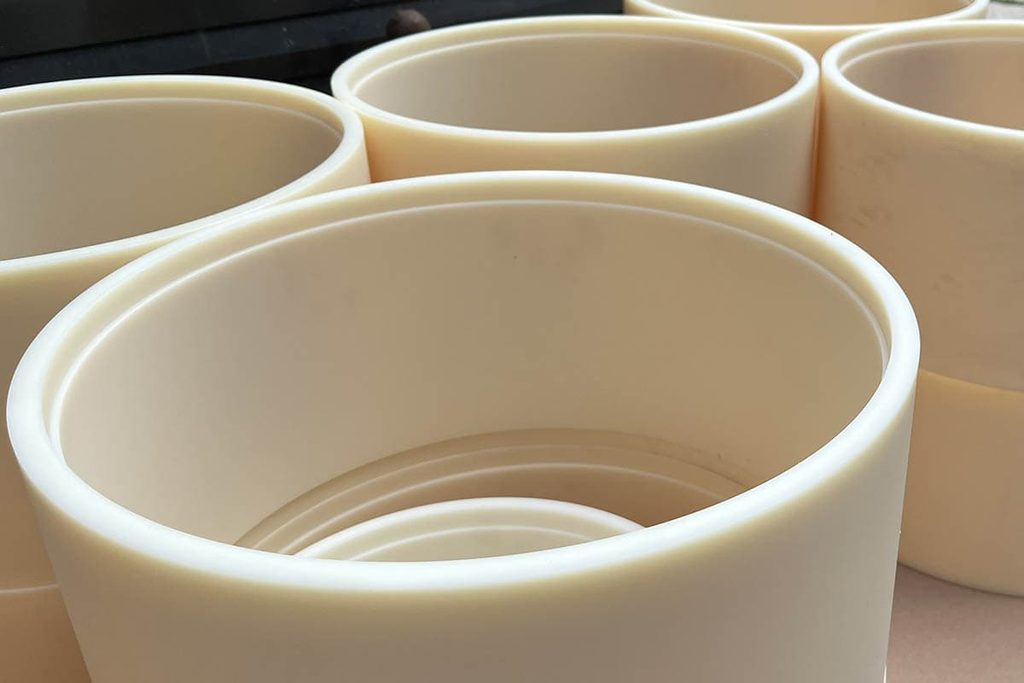
Polyamide PA6 is used in a wide range of industrial sectors. It is very commonly used in mechanical engineering, production lines, transportation technology, and the automotive industry.
Typical PA6 products include, for example:
- sliding bushings,
- guide rails,
- gears,
- pulley,
- pulleys,
- rollers,
- spacer rings,
- stops,
- bearing components,
- guide elements,
- pads,
- covers,
- structural panels,
- brackets and supports,
- other machine and structural components.
Another advantage is the ability to produce complex-shaped parts from PA6 using CNC milling and turning.
CNC Machining of PA6 Polyamide
From the perspective of machining, polyamide is a highly suitable material; however, its machining differs from that of metals in several respects.
Plastics have a different coefficient of thermal expansion, lower stiffness, and dissipate the heat generated during machining in a different way. Therefore, it is important to use the appropriate tool geometry, correct cutting conditions, the proper workpiece clamping method, and ensure effective chip removal.
For precision products, it is also necessary to account for possible internal stresses in the semi-finished product and for dimensional changes in the material caused by temperature or humidity.
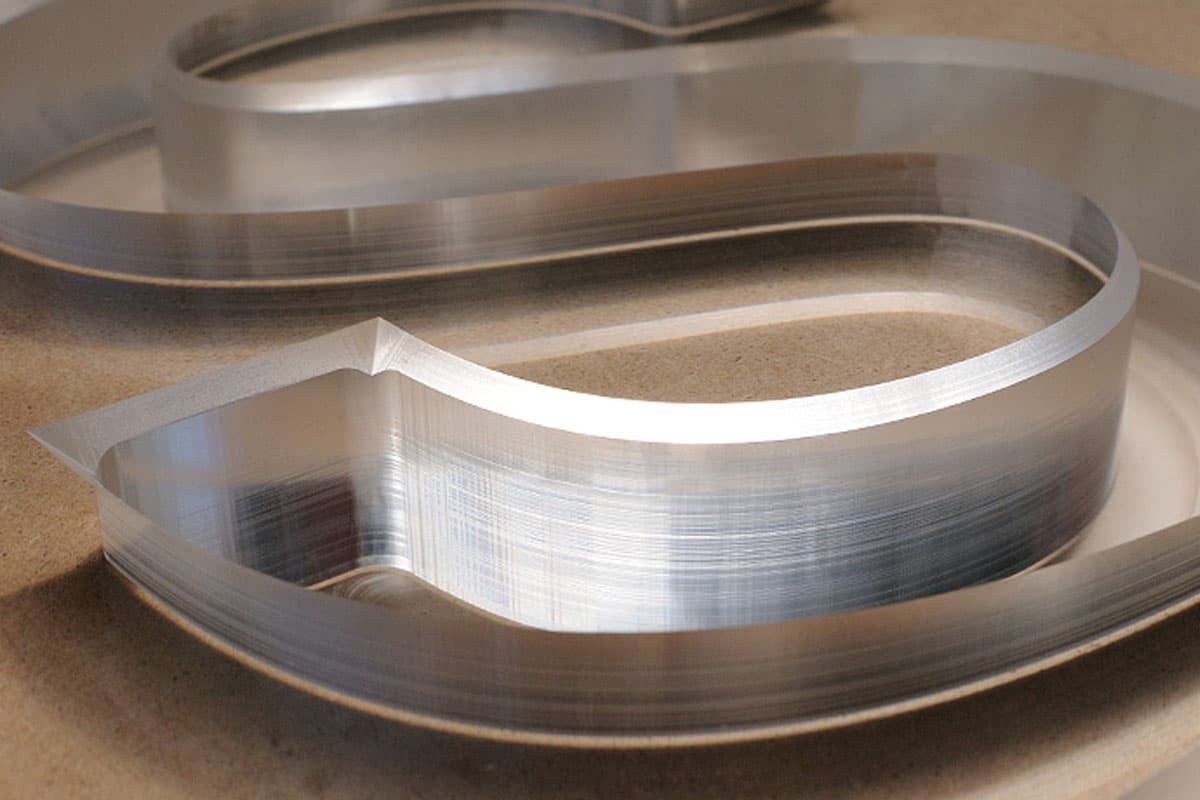
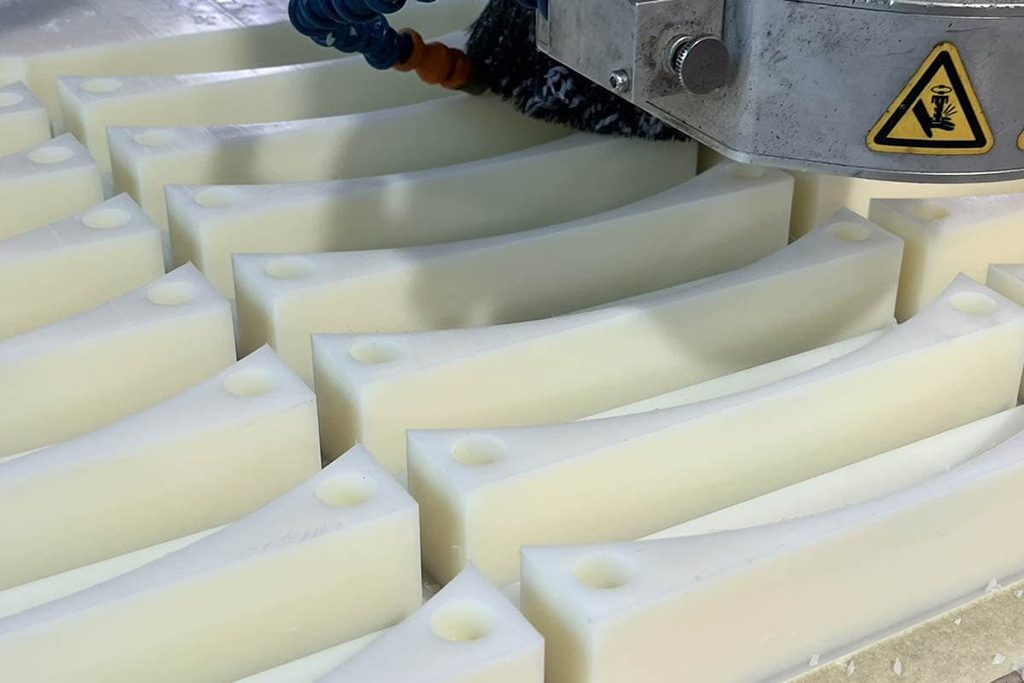
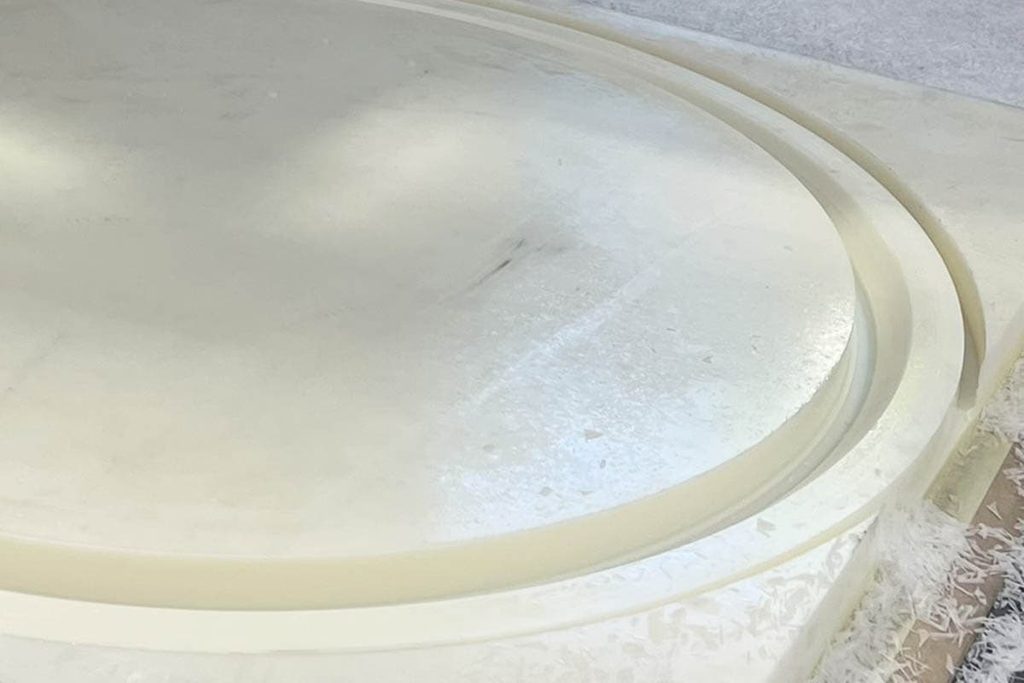
The right technology ensures a high-quality surface finish and precise dimensions, even for complex engineering parts
CNC Milling of PA6
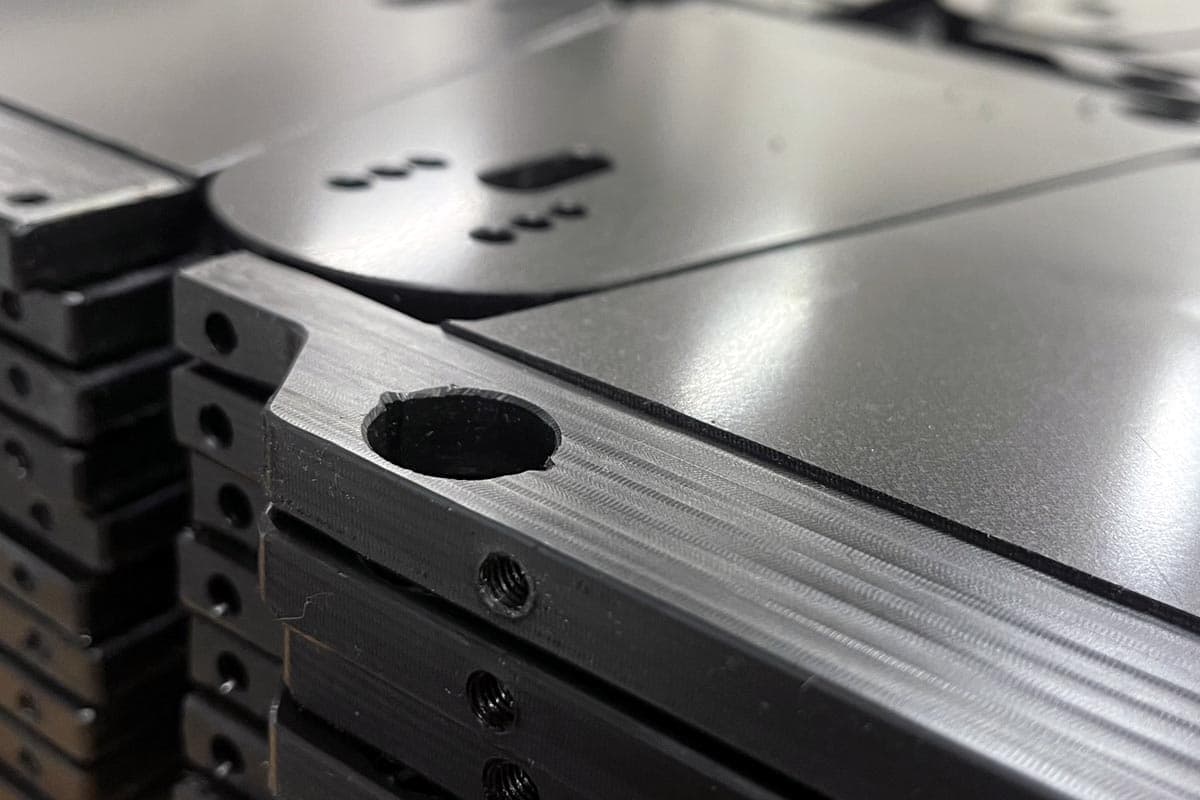
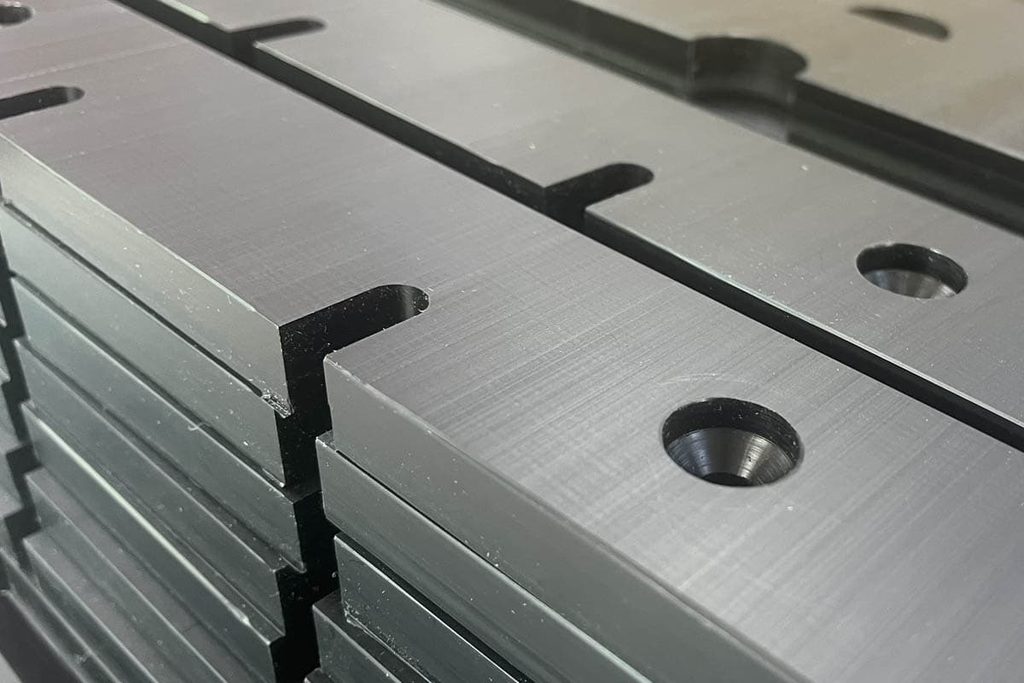
We primarily use CNC milling of PA6 polyamide in the production of parts from sheets, blocks, and other suitable semi-finished products.
Milling can be used to create, for example:
- the outer contours of the part,
- pockets and cutouts,
- holes,
- grooves,
- mounting,
- recess,
- threads,
- curved surfaces,
- assembly and structural components.
CNC milling is suitable for both simple flat parts and more complex, contoured parts.
Another advantage of CNC technology is its high repeatability. Once the manufacturing process is set up, additional identical parts can be produced efficiently. PA6 milling is therefore suitable not only for prototypes and small batches, but also for mass production.
At REONTECH, we have CNC milling machines with a working area of up to 3100 × 2100 mm, which allows us to machine even larger parts and sheet materials.
CNC Turning of PA6 and Silon
CNC turning of PA6 is a suitable technology for rotary parts.
Nylon (or polyamide) rods and other suitable semi-finished products can be used to manufacture, for example:
- sliding bushings,
- spacer sleeves,
- rings,
- rollers,
- pulleys,
- pulley,
- stops,
- guide elements,
- mounted rotating components.
When turning polyamide, it is important to clamp the material properly. Excessive clamping forces can deform the plastic blank and negatively affect the accuracy of the finished part.
Just as with milling, it is necessary to adapt the tools and cutting conditions to the properties of the engineering plastic.
At REONTECH, we perform CNC turning of engineering plastics, including PA6, and can machine turned parts up to 500 mm in diameter. Depending on the nature of the product, turning can also be combined with subsequent milling.
Is PA6 the same as nylon?
PA6 is polyamide 6. The term “Nylon 6” is also used to refer to this polymer-based material. However, the term “nylon” itself is broader and can also refer to other types of polyamides.
Is Silon the same as PA6?
In the Czech context, “Silon” is the traditional term used to refer to polyamide 6. In technical documentation, it is preferable to use the precise designation PA6.
What is the difference between PA6 and PA66?
PA6 and PA66 belong to the same group of polyamides but have different properties. PA66 generally offers higher stiffness, hardness, and better performance at higher temperatures, while PA6 is a highly versatile and tough engineering plastic.
What is PA6+oil?
PA6+oil is a modified polyamide with lubricant incorporated directly into the material. As a result, it has excellent sliding properties and wear resistance. It is used, for example, in bushings, plain bearings, guides, pulleys, and other moving machine parts.
What does PA6 GF30 mean?
PA6 GF30 is a PA6 polyamide reinforced with approximately 30% glass fibers. It is characterized by higher strength, stiffness, and dimensional stability than standard PA6.
What is PA6G?
PA6G is a cast polyamide 6. It is also sometimes referred to as PA6 C or cast Nylon 6. It is used, among other things, for pulleys, gears, sliding components, bushings, and other mechanically stressed machine parts.
What kinds of products are made from Silon?
Typical products made from Silon, also known as PA6, include sliding bushings, gears, guide elements, pulleys, rollers, belt pulleys, spacer rings, washers, and other technical components.
Is PA6 suitable for precision parts?
Yes, but during the design phase, it is necessary to account for moisture absorption and the associated dimensional changes. For applications with very tight tolerances, it is therefore necessary to assess the operating conditions and, if necessary, consider using a different engineering plastic.
Do you need to manufacture parts made of polyamide?
Are you looking for a reliable partner for CNC machining of polyamide PA6, PA66, PA6+oil, Nylon, or Silon? We provide CNC milling and turning of engineering plastics, ranging from single pieces and prototypes to repeat and mass production. Send us a drawing, 3D model, or sample of the part you need, and we’ll prepare a suitable manufacturing solution and a price quote. Contact us to request a quote for CNC machining of your polyamide part.